Your watch reports heart rate variability as a number at the end of the day, when you can do nothing with it. EmoDrink turns it into one suggestion.
Your smartwatch has been measuring your heart rate variability all day. It knows roughly how recovered you are, roughly how much load you are carrying. Then it hands you a number between 0 and 100, usually at a moment when there is nothing you can do about it.
That is the gap EmoDrink is about. Not sensing, which is largely solved and sitting on your wrist right now, but the last step: turning an invisible internal signal into something a person can actually act on.
The work was built through 2025 with Asahi as industry partner, and presented at Augmented Humans 2026 in Okinawa. The paper is EmoDrink: An Embodied MR Framework for Physiology-Informed Beverage Recommendations.
Pick a drink
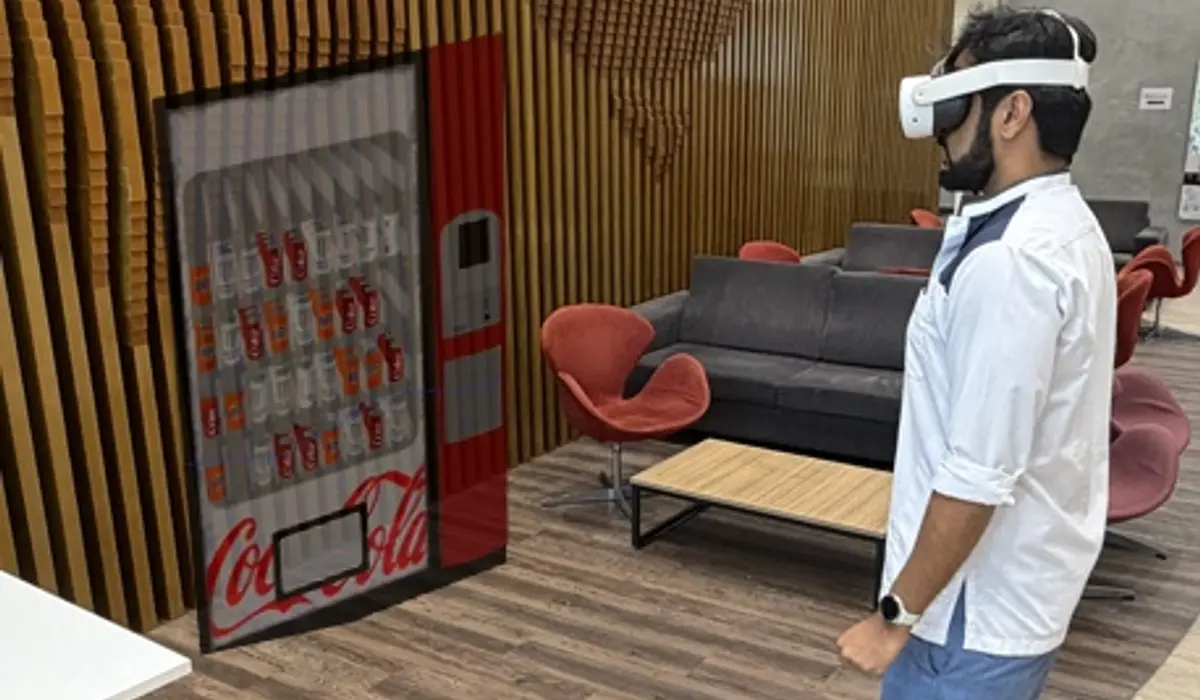
The scenario is deliberately, almost aggressively mundane. You are standing in front of a vending machine and you have to choose something to drink.
We picked it because nobody needs it explained, and because for Asahi it is not a hypothetical: a vending machine is a real surface where a real recommendation has to land in a few seconds. There is no domain to learn, no task to train on, no expertise that separates one participant from another. Everyone has stood in front of a vending machine feeling mildly indecisive. That familiarity is what makes the scenario useful: it clears the frame so the only interesting thing left in it is how the recommendation was delivered.
The system reads four things:
- Physiology from a Garmin Venu 3S, mostly a short HRV window
- Self-report on mood, sleep quality, and energy
- Context about the moment
- A recommendation backend that produces one suggestion and a rationale for it
At the start of a session you wear the watch and sit still for about a minute while it captures the HRV window. Those readings stream to the backend, get combined with what you said about your own state, and come back as a single drink from a curated set of over 40, organised by function: calming, hydrating, and so on.
One decision underneath all of that matters more than it looks. We map the incoming signal to a coarse arousal-valence model rather than claiming a specific emotion. The system never says "you are anxious". It is built to be suggestive, not diagnostic, and that constraint was deliberate from the start. Physiological inference is noisy. A system that hides its own uncertainty behind a confident label is making a promise the sensor cannot keep.
The actual experiment
Here is the part that makes this a research question rather than a demo.
The recommendation never changes. Only the thing delivering it does.
Same drink, same rationale, three bodies:
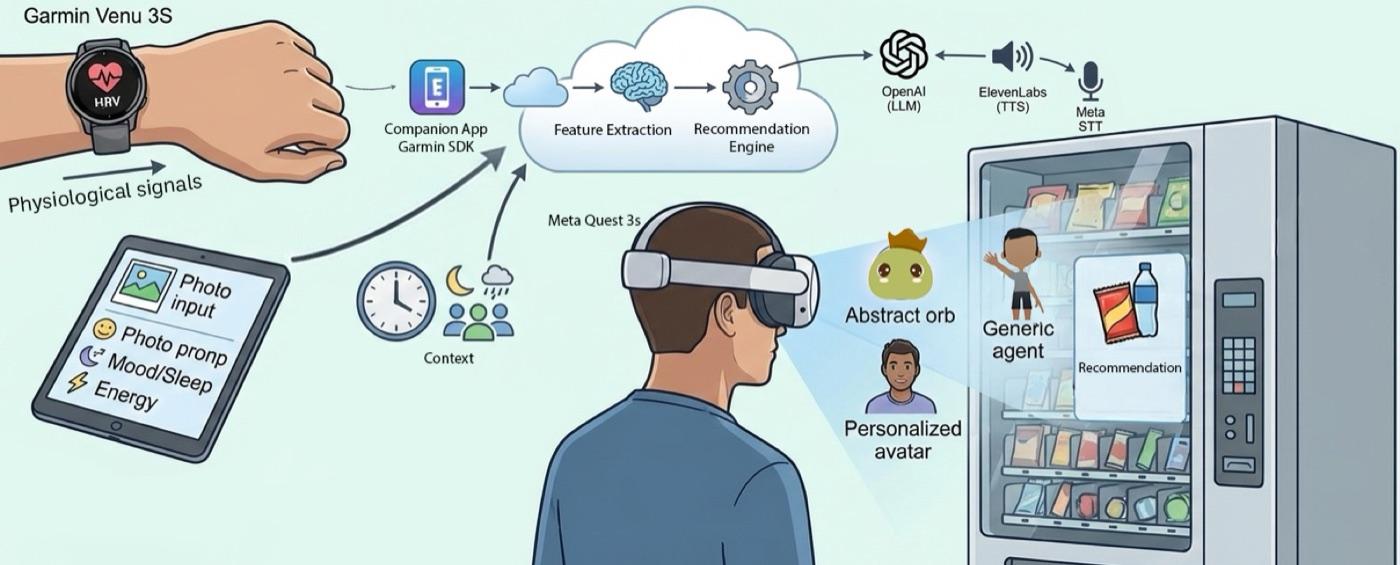
- An abstract orb. A minimal data visualisation. No face, no voice, no social presence.
- A generic agent. A stylised humanoid figure. Present, but nobody in particular.
- Your own avatar. A future-self representation built from a photo we capture on a tablet during onboarding.
Holding the content constant and varying only the embodiment isolates the design variable we care about: does the same advice land differently depending on who appears to be giving it?
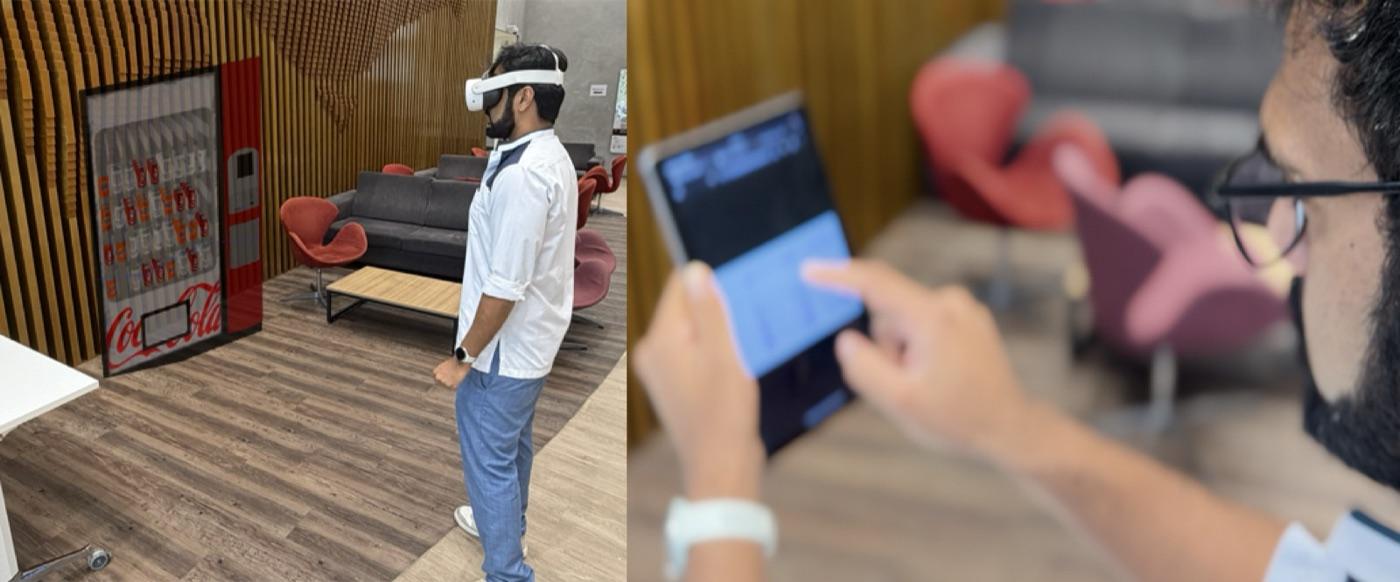
The whole thing is Unity on a Quest 3 in passthrough, so the vending machine and the agents are spatially anchored in your actual room. Natural-language explanations are generated from the recommendation and its rationale, with speech synthesis and recognition for lightweight back-and-forth. Participants moved through all three modes within a single session, which is what lets you compare them without cross-participant noise swamping the effect.
What we saw, and why it complicates things
These are early pilot observations rather than a completed study, so read them as a direction rather than a result.
Personalised avatars were often perceived as more trustworthy and more socially present. That is the finding you would predict, and on its own it reads like a straightforward win for higher embodiment.
The interesting part is the other half. When the recommendation felt wrong, the personalised avatar was also the most uncomfortable to receive it from. Being told something inaccurate about your internal state by a figure wearing your own face is worse than being told the same thing by a floating orb. The orb is easy to dismiss. That is its weakness when the system is right, and its saving grace when the system is wrong.
So embodiment is not a dial you turn up. It amplifies in both directions:
Higher embodiment raises engagement and trust when the inference is good, and raises the cost when the inference is bad.
For any system built on physiological inference, that trade-off is the design problem, because physiological inference is never reliably good. You are choosing how much to amplify a signal you already know is noisy.
Why I think this generalises
Very little of this is really about drinks.
Wearables have quietly won the sensing argument. The watch on your wrist captures meaningful indicators of stress, recovery, and affect, continuously, for years. What none of them have solved is the last few centimetres: getting that signal back to a person in a form they can use, at a moment when using it is still possible.
The default answer has been dashboards. Charts, scores, weekly summaries. Dashboards put the entire interpretive burden on the user, and they do it hours after the moment they describe.
EmoDrink is an argument that mixed reality can carry that information differently: spatially, in the moment, and embodied. Not because embodiment is inherently better, but because it is a real design space with real trade-offs, and we have barely mapped it.
It is also the same question I keep circling from other directions. Involuntary Signals asked whether a system should act on what your body leaks without your intent. Zenflow asked how gradually a system should pull you out of the real world. EmoDrink asks who should be standing there when it tells you what it thinks it knows.
The part that worried us
Embodied agents make inferred states feel more authoritative than they are. A figure with a face saying "you seem depleted, try this" carries a weight that a number on a wrist does not, and it carries that weight whether or not the inference is any good.
We handled it in three ways, all of them constraints rather than features:
- Coarse, non-diagnostic inference. Arousal and valence, never a clinical-sounding label.
- Suggestive framing. Recommendations are offered, not prescribed.
- Nothing is retained. Physiological data and the personalised avatar exist for the duration of the session and are then gone.
That last one costs us something real. A system that remembered you across sessions could give far better recommendations. We chose not to build that, because a photorealistic future-self avatar backed by a persistent physiological history is a genuinely uncomfortable object, and the demo did not need it to answer the question we were asking.
The framework is extensible by design: other domains, other sensors, other embodiments. But the question underneath stays the same one, and I do not think it is close to settled. If a machine can see something about you that you cannot see about yourself, what should it look like when it tells you?